
I used to think I had a time management problem. Turns out, I had a honesty problem. I was spending two hours a day on my phone, forty-five minutes on email that could have taken fifteen, and roughly an eternity in meetings that should have been emails — and then complaining that there weren’t enough hours in the day.
The day has twenty-four hours. It had twenty-four hours when Leonardo da Vinci was painting the Sistine Chapel ceiling. (Wait — that was Michelangelo. See? I should have been reading instead of scrolling.) The issue is almost never how many hours you have. It’s where they go.
These six strategies helped me stop bleeding time and start using it. They’re not revolutionary. They’re not even particularly clever. But they work, which puts them ahead of about 90% of the productivity advice on the internet.
1. Plan Your Day by the Hour, Not the Vibe
Most people start the day with a vague sense of what needs to happen and then react to whatever lands in their inbox. By lunchtime, they’ve been busy for four hours but haven’t done any of the things they intended to do. Sound familiar?
The fix is stupidly simple: write down what you’re going to do and when. Not a to-do list. A schedule. “9:00–10:30: finish report. 10:30–11:00: respond to emails. 11:00–12:00: project research.”
Will the schedule survive contact with reality? Rarely, in its entirety. But having a plan you deviate from is infinitely more productive than having no plan at all. The plan gives you something to return to when you get derailed. Without it, a derailment becomes a lost day.
Use whatever tool you like — paper planner, phone calendar, sticky notes on your monitor. The tool doesn’t matter. The habit of deciding in advance how your hours will be spent is what matters.
2. Separate the Urgent from the Important
President Eisenhower reportedly said, “What is important is seldom urgent, and what is urgent is seldom important.” The man ran a world war and a country, so he probably knew something about prioritization.
His matrix is a simple four-quadrant grid: important and urgent (do it now), important but not urgent (schedule it), urgent but not important (delegate or minimize), and neither urgent nor important (eliminate). Most people spend their entire day in quadrants three and four — answering messages that feel urgent but aren’t important, and scrolling through content that’s neither — while the genuinely important work sits untouched.
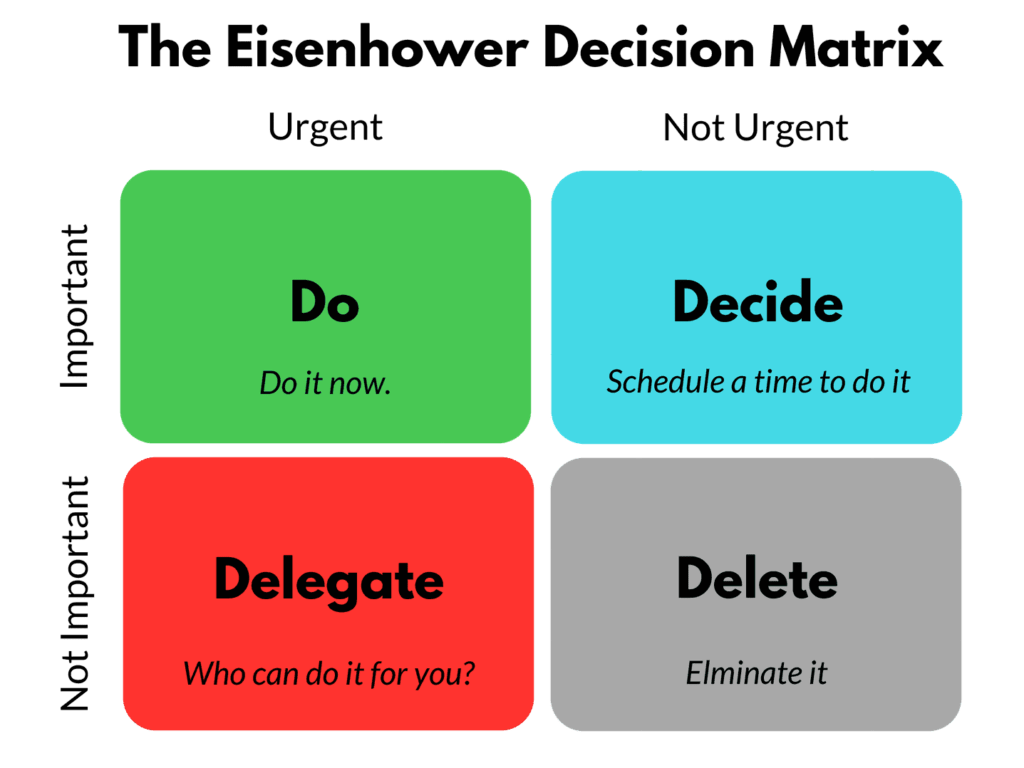
Try this: at the start of each day, identify the single most important task. Not the most urgent. The most important. Do it first, before your inbox has a chance to hijack your attention. Everything else fills in around it.
3. Start with What’s Easy (Seriously)
There’s a popular productivity philosophy that says you should “eat the frog first” — tackle the hardest task before anything else. And for some people, that works. For the rest of us, staring at a massive, intimidating project first thing in the morning produces paralysis, not progress.
An alternative that I’ve found more reliable: start with something small and completable. Answer three emails. Organize your desk. Write the first paragraph of the report, even if it’s bad. The purpose isn’t the task itself — it’s the momentum. Completing something, anything, generates a micro-dose of accomplishment that makes the next, harder thing feel more approachable.
Think of it as warming up before the heavy lifts. Nobody walks into a gym and deadlifts their maximum weight cold. Your brain works the same way.
4. Find Your Time Vampires
For three days, set an alarm to go off every thirty minutes. When it rings, write down exactly what you’re doing at that moment. No editing, no flattering — raw truth.
I did this exercise two years ago and the results were mortifying. At least a third of my “work day” was consumed by activities that produced exactly nothing: checking social media, reading news articles I’d forget by dinnertime, reorganizing files that didn’t need reorganizing, and having conversations that could have been handled in two sentences instead of twenty minutes.
You can’t fix a leak you can’t see. This exercise makes the leaks visible. Once they are, the solutions are usually obvious: batch your email into two or three daily check-ins instead of refreshing constantly, put your phone in another room during deep work blocks, and learn the phrase “can we take this offline?” for meetings that have veered into irrelevance.
5. Negotiate with Your Inner Child
There’s a model in psychology called Transactional Analysis that describes three internal states: the Parent (responsible, planning, rule-following), the Adult (rational, present, adaptive), and the Child (playful, impulsive, resistant to work).
When you can’t bring yourself to start a task, your inner Child is running the show. And yelling at the Child — “Just do it! Stop being lazy!” — rarely works. What works better is bargaining.
“Finish two hours of focused work, and then you can spend thirty minutes doing whatever you want.” “Get through this report, and we’re taking a walk and getting coffee.” It sounds ridiculous. It works. Because the resistance isn’t rational, so the solution doesn’t need to be rational either. It just needs to acknowledge that part of you would rather be anywhere else, and offer it something worth cooperating for.
6. Never Multitask. Ever.
I know. You think you’re good at multitasking. You’re not. Nobody is. What you’re actually doing is task-switching — bouncing between activities — and every switch costs you time, focus, and mental energy. Research consistently shows that people who “multitask” take longer to complete each individual task, make more errors, and experience higher stress levels than people who work on one thing at a time.
Single-tasking feels slower. It isn’t. A focused hour produces more high-quality output than three scattered hours of bouncing between your inbox, a spreadsheet, a Slack conversation, and whatever your phone just buzzed about.
Close the tabs. Silence the notifications. Work on one thing until it’s done or until you’ve hit your scheduled time limit. Then move to the next thing. It’s boring. It’s effective. And effective beats exciting every time.
The Uncomfortable Truth
Time management isn’t really about managing time. It’s about managing yourself — your impulses, your distractions, your tendency to confuse being busy with being productive.
You have the same twenty-four hours as everyone else. The question isn’t whether you have enough time. It’s whether you’re willing to be honest about where it goes, and disciplined enough to redirect it toward things that actually matter.
Start there. The rest is just mechanics.